Hoodline reported that, on April 7, 2026, a Cook County judge denied an injunction that would have paused construction on Old Town Canvas, developer Fern Hill's 36-story apartment tower planned for the corner of North Avenue and LaSalle Drive. Days later, a related ruling went further: the judge dismissed the condo association's lawsuit outright, and not because a jury weighed the merits of a 36-story building rising where a Walgreens and a parking lot for Moody Church currently sit. The issue was notice. Illinois law requires anyone challenging a zoning ordinance to notify every property owner within 250 feet of the site, and the plaintiffs, the 1660 N. LaSalle Condominium Association, hadn't done it.
If you're comparing Old Town to Lincoln Park or Gold Coast right now, this ruling matters less for what it says about one tower and more for what it reveals about how the neighborhood actually works. Old Town isn't one market. It's two regulatory zones stitched together, and which one your address sits in changes what you're buying.
What the ruling actually settled, and what it didn't
The 1660 N. LaSalle Condominium Association sued Fern Hill's development entity, the City of Chicago, and the city's planning department in July 2025, arguing the rezoning process for Old Town Canvas violated due process and skipped required community notice. As reported by the Chicago Sun-Times, attorney Gene Murphy, representing the association, called the project "the main, gigantic elephant in the room" and argued a 36-story tower doesn't belong in what he described as one of the most congested parts of the city.
Cook County Circuit Court Associate Judge Myron Mackoff didn't rule on whether the tower belongs there. He ruled that the association missed a filing requirement. A status hearing was set for May 18, 2026. But the practical effect, confirmed in reporting from The Real Deal, is that the city's zoning approvals stay intact and Fern Hill keeps moving toward permits and site work while the case continues.
That's the transaction-relevant lesson for anyone touring condos near this corridor this year. A lawsuit in progress doesn't mean construction pauses. If a listing agent or seller tells you a nearby project is "still being fought," ask whether that fight has produced an actual stay of construction. In this case, it hasn't.
The number that matters more than the tower
Old Town Canvas itself, at 349 apartments including 70 income-restricted units, is not really the story. The story is what got rezoned to make it possible. According to Save Old Town Chicago, the community group organized against the project, the rezoning approved Planned Development 89, which now covers roughly one million square feet of entitled land across multiple parcels, including the Moody Church campus, the historic Piper's Alley site, and the former BP and Shell gas station lots along that stretch.
The practical consequence: future towers within PD 89 don't require new public hearings or a new City Council vote. The zoning fight over one building effectively pre-cleared the runway for whatever comes next on that block.
Fern Hill has framed its approach differently, describing its work as growing out of years of community meetings and stakeholder feedback that shaped the final design. Both things can be true. The community process happened, and it also produced an entitlement that outlasts the building it was created for.
Two Old Towns, one zip code
Here's what makes this relevant to a buying decision rather than just neighborhood trivia. The Old Town Triangle Historic District, designated a Chicago Landmark on September 28, 1977, sits under a completely different regulatory regime than the North Avenue and LaSalle corridor a few blocks away, and the two areas even answer to different aldermen: the Triangle falls in the 43rd Ward, while the Old Town Canvas site is in the 2nd Ward under Alderman Brian Hopkins.
| Old Town Triangle (landmark core) | North Ave / LaSalle corridor (PD 89) | |
|---|---|---|
| Governing review | Historic review | Entitled under a planned development; future construction can proceed without new hearings |
| What triggers review | Exterior changes | Already cleared; no equivalent trigger for the developer |
| Meeting cadence | Third Tuesday monthly at the Triangle Center, 1763 N. North Park Avenue | No recurring public review required for future phases |
| Buyer's practical question | How might local review affect my renovation plans? | What's the next phase of PD 89, and does it affect my view or my block's traffic pattern? |
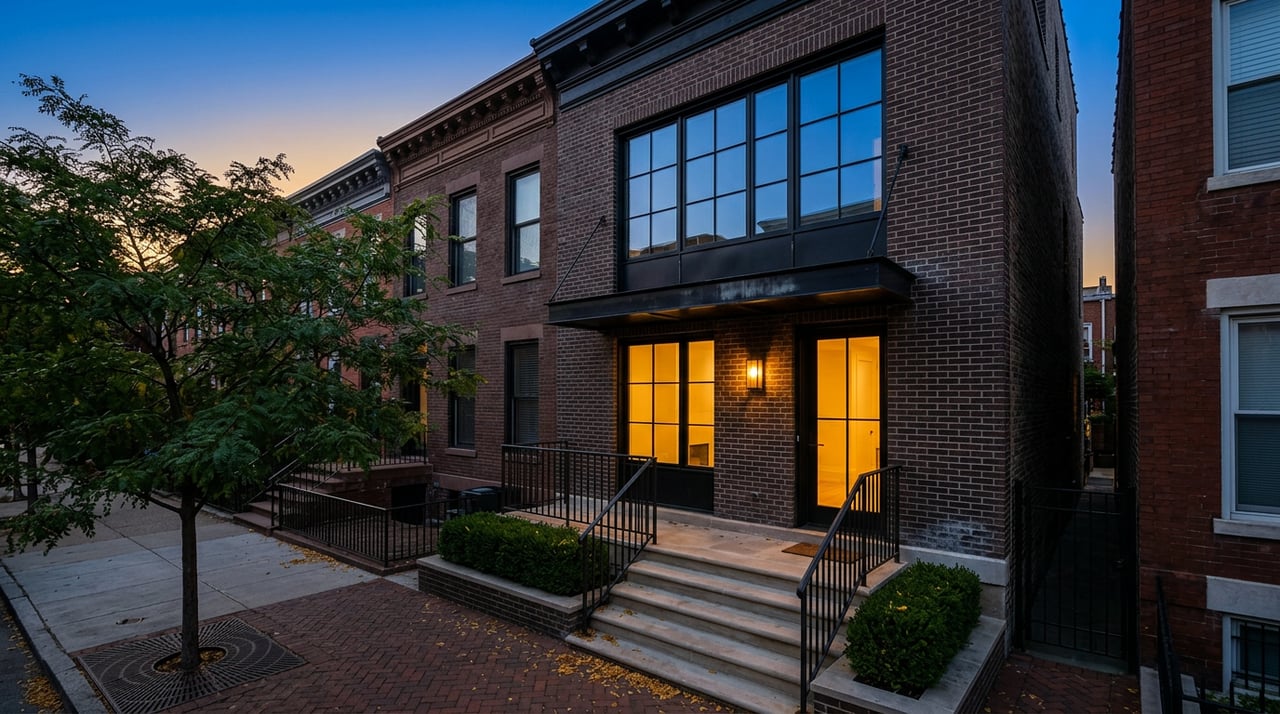
If you're buying a Victorian cottage or a rowhouse inside the Triangle, your renovation plans may involve local review. If you're buying a unit near LaSalle Drive, your renovation timeline is probably simpler, but your neighborhood's build-out is largely out of your hands and already locked in.
What this means when you're touring
A few blocks in Old Town can put you in either category, and the difference shows up in your buying strategy more than in the finish level of the kitchen.
Before you write an offer near the North Avenue and LaSalle corridor, ask your agent to check where the parcel sits relative to PD 89's boundaries. Ask whether the unit's primary view faces the entitled development zone. Ask what Fern Hill's committed traffic plan, a $1 million investment in signal timing, turn lanes, and pedestrian improvements at multiple intersections, actually changes for your specific corner, since some of that work will happen during construction rather than after it.
Before you write an offer inside the Triangle, ask for the property's history with the Landmarks Commission.
Pricing reflects both stories. Condos in Old Town generally run from the mid $200,000s for a one-bedroom up to the mid $700,000s for a two-bedroom, with townhomes typically landing between $700,000 and $1.5 million depending on size and condition. Renovated or new-construction single-family homes on the most sought-after historic blocks, particularly near North Park Avenue and Wieland Street, reach $2 million to $3 million. None of those numbers tell you which regulatory zone you're buying into. Only the address does.
Why this is our lane
Reading an entitlement like PD 89 and understanding what it means for a specific block isn't a skill every agent brings to a walkthrough. It's closer to the developer advisory work we did on Orchard Private Residences, where pricing a boutique building meant understanding zoning capacity before a single unit was marketed. That same lens applies when you're the buyer, not the developer. If you're weighing Old Town against Lincoln Park or comparing vintage walk-ups to newer mid-rises within Old Town itself, the entitlement map matters as much as the floor plan.
FAQ
Does the pending lawsuit mean construction on Old Town Canvas is paused? No. The April 2026 ruling denied the injunction that would have paused work, and the subsequent dismissal was on procedural grounds rather than the underlying zoning challenge. At the time, permitting and pre-construction steps were continuing, and a status hearing was scheduled for May 18, 2026.
What should I check before updating windows in a condo inside the Old Town Triangle? Check the property's review history before planning a window update.
Is the North Avenue and LaSalle corridor a bad place to buy because of PD 89? Not necessarily. It means future development risk and opportunity are both higher there than in the landmark core. Some buyers want that upside. Others want the predictability of a fully protected block. Neither answer is wrong, but you should know which one you're choosing.
Curious how a specific Old Town address maps onto this entitlement picture, or ready to compare it against Lincoln Park in real numbers? Work with Cadey O'Leary Collection to get the block-by-block read before you write an offer.
This article is general information, not legal, tax or financial advice. Consult a qualified professional about your situation.